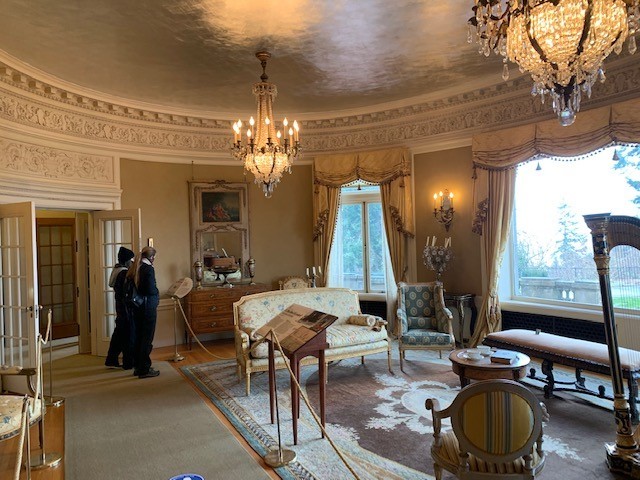
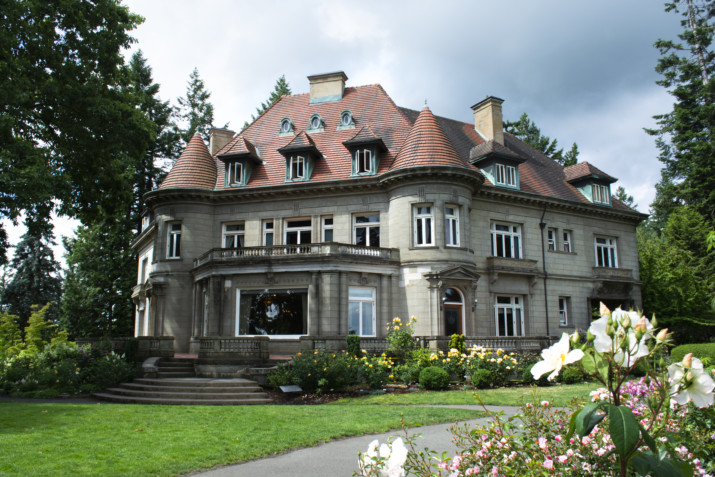
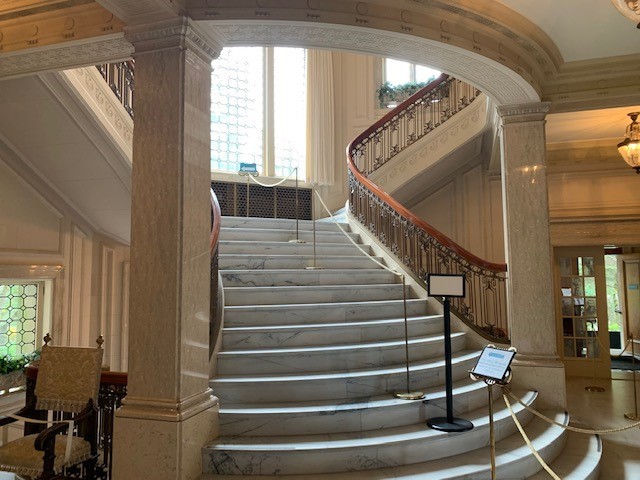
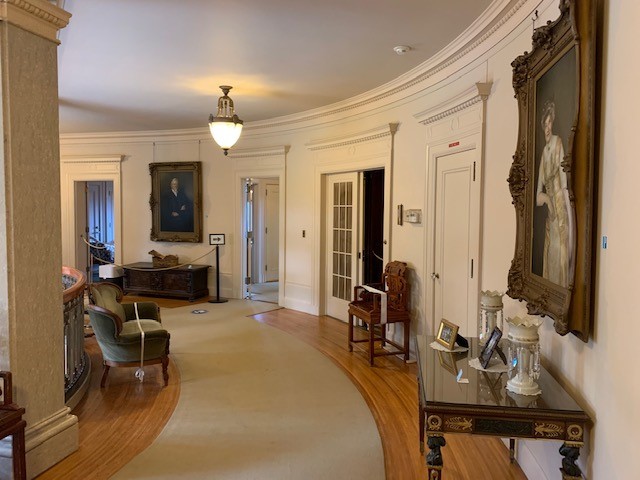
Portland, OR. The Pittock Mansion is open to the public again and administrators say they’re hoping visitors will return. Associate Director Jennifer Gritt explains, “We are thrilled to be able to reopen to the public. The year-long pandemic and multiple closures have resulted in an 80% drop in Admissions revenue which has had a significant impact on the organization.”
Gritt says the staff has been reduced both in number and scheduled hours. The nonprofit has been able to take advantage of federal and state aid including a grant and the PPP loan program. “We hope we are moving past the need for additional closures to help stop the spread of COVID-19, and once we are confident we’ll be able to remain open, we will start the slow process of rebuilding. We have seen an increase in donation support which is much-needed as we work to bridge the budget gaps created by significantly reduced revenue.”
Pittock Mansion is supported by general admission, memberships, donations, grants, and museum store purchases.
In 2007, the nonprofit Pittock Mansion Society took over museum operations. The Society works in collaboration with Portland Parks & Recreation to operate and preserve the historic buildings.
The Pittock Mansion is a French Renaissance-style château in the West Hills of Portland. The mansion was originally built in 1914 as a private home for London-born Oregonian publisher Henry Pittock and his wife, Georgiana Burton Pittock.
Gritt explains, “While the pandemic and closures have been challenging, we are also learning a lot about what is important to visitors and the visitor experience. The limitations on the total number of visitors at one time and the socially distanced one-way path have resulted in a much more intimate and enjoyable tour of the Mansion. Visitors are able to spend some time and really take in everything the museum has to offer. We hope to be able to carry this forward into the future.”
Information about visiting the Pittock Mansion:
Built in 1914, Pittock Mansion tells the story of Portland’s transformation from a pioneer town to a modern, industrialized city through the history and legacy of one of its most influential families, the Pittocks. Saved from demolition by dedicated citizens in 1964, the Mansion and surrounding estate were purchased by the City of Portland and opened to the public as a historic house museum.
Current visiting guidelines: Face coverings are required when indoors and when around other guests or staff unless an accommodation for people with disabilities or other exemption applies. Face coverings are recommended but not required for visitors between the ages of 2 and 5.
Tickets are timed and must be purchased online. Please purchase before arriving. All transactions—both tickets and Museum Store—are credit card only. No cash. Exchange requests will be reviewed on a case by case basis.
Members can reserve a time and check in with guests online using their Member ID number.
Entry and exit into the Mansion will be one-way and individual groups/parties will have a staggered entry from other individual groups/parties.
Maximum group size is limited to 10 people. Please note: there might be a short wait outside the Mansion before entry.
Six-feet distancing will be enforced in lines and within the Mansion and Museum Store.
Follow all capacity and one-way directional instructions throughout the Mansion and the Museum Store as stated by staff and signage.
Hand sanitizer will be available at main entrance and exit of the Mansion and Museum Store. Restrooms are also available inside the Mansion. We ask all visitors to follow CDC and Oregon Health Authority guidelines regarding handwashing and hand sanitizing.
Please refrain from touching surfaces and objects inside the Mansion and Museum Store (unless purchasing). Entry and exit from the Mansion and the Museum Store will be touchless.
There will be no access to drinking fountains within in the museum.
Elevator will be available for visitors with mobility issues but will be limited to two people per group. Visitors must be comfortable being in the elevator on their own. The elevator will be controlled by staff from the hallways on each floor. Other restrictions may apply.
Avoid visiting if you are experiencing symptoms related to COVID-19, have been exposed to someone who has tested positive within 14 days, or have traveled to areas with known travel restrictions within the last 14 days.
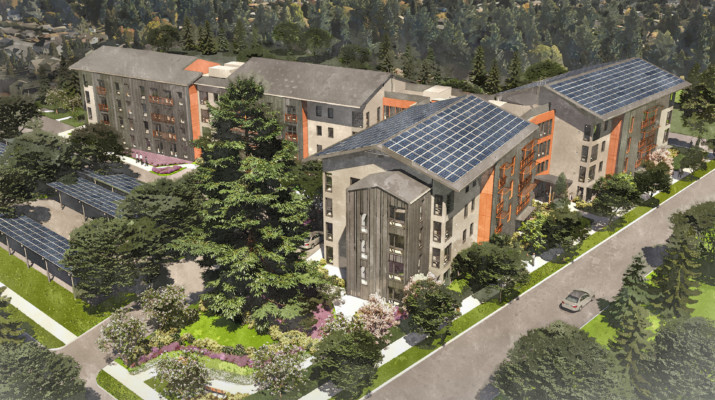
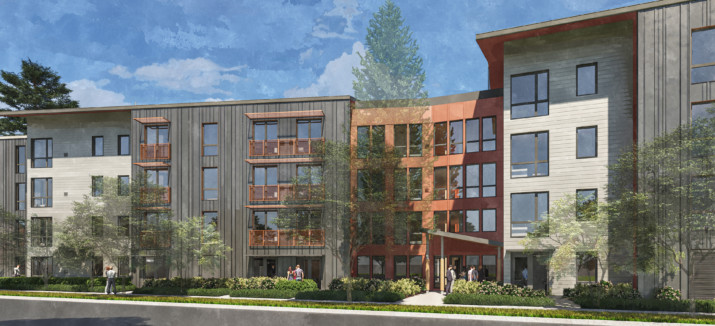
Portland, OR. After four years of planning, Albertina Kerr is beginning construction on 150 low-cost housing units on the Gresham campus for Kerr caregivers and improved client care. (Above is an architectural drawings.) On February 17th, the organization had a virtual groundbreaking.
Once completed, this project will be one of the first and largest net-zero affordable housing projects in the Pacific Northwest producing enough energy to operate the entire building fully.
Albertina Kerr has been caring for Oregon’s vulnerable citizens since 1907, with services that have evolved over the years to meet community needs. Kerr offers short-term psychiatric care and community-based outpatient mental health services for children and teens. This also includes 24-hour residential group homes for children and adults experiencing an intellectual and/or developmental disability (I/DD).
In the virtual groundbreaking, guests were introduced to several community leaders who have been a part of getting the project off the ground. Joining the live stream to discuss the project were:
Ken Thraser, Albertina Kerr Emeritus Board Member, also spoke in the live stream about what this project could look like for other organizations as well, “This is kind of going to have a ripple effect. Not just for Kerr, but for the community, for other non-profits, for other organizations that will look at workforce housing as a strategy that they too could do.”
Albertina Kerr unveiled its Workforce & Inclusive Housing Project during a virtual groundbreaking, which can be viewed in the live steam video below.
During the live stream event, Albertina Kerr’s CEO, Jeff Carr, shared stories about the affordable housing project targeting low-wage human services workers and adults experiencing I/DD.
As Carr shared in the live stream, the idea for the Workforce & Inclusive Housing Project came to him after speaking with one of his managers in 2016. Carr learned that one of the direct care employees lived in a tent with her five children in Washington County. He also learned that some other employees were sleeping in their cars or couch surfing.
He immediately relocated the direct care employee and her five children to a hotel as he took time to think about this issue. After 48 hours, the idea came to him during an early morning run where later that day, he told his assistant that they were going to build housing for workers.
“Those who care for the most vulnerable in our community are the backbone of our social safety net. If they become as vulnerable as the people, they care for due to housing instability, our entire community is at risk,” said Carr.
Chief Program Officer, Derrick Perry, also spoke in the live stream about the project, “I’m just really happy to be aligned with an organization that cares so much about the people we support and our workforce, to where we’re launching this huge project.”
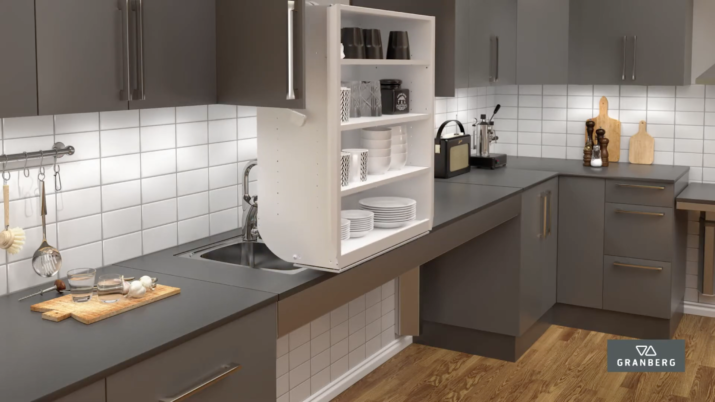
One aspect of the universally accessible units will be hydraulic upper cabinets as well as pull-out cooktops.
When completed in the spring of 2022, one hundred and twenty units of studio, 1, 2, and 3-bedroom apartments will promote greater workforce stability for low-wage caregivers (Kerr employees and others).
Throughout the complex will be an additional 30 universally accessible units for adults experiencing I/DD. These individuals face a shortage of quality, affordable, accessible housing and often earn 30% or less than the average median income.
Solar panels will be placed on the apartment complexes to produce renewable energy, adding another layer of affordability where residents won’t pay for utilities, including high-speed internet access. Once built and occupied, one full year of collecting energy usage data will be completed and certified.
From Albertina Kerr’s website: MISSION: Kerr empowers people with intellectual and developmental disabilities, mental health challenges, and other social barriers to lead self-determined lives and reach their full potential. VISION: All people thrive in nurturing and inclusive communities. VALUES: The values of our expert caregivers remain constant: compassion, commitment, collaboration, and advocacy.
Portland, OR. Portland Center Stage‘s annual gala, Metamorphosis, was held virtually on February 20th and raised over $315,000. 551 guests attended this online celebration of theater. Delphon “DJ” Curtis Jr. performed as Hedwig for a sing-a-long of “Wig in a Box” as seen above. (Video stills by Mikey Mann, courtesy of Portland Center Stage.)
The evening was emceed by Artistic Director Marissa Wolf, Associate Artistic Director Chip Miller, and auctioneer Johnna Wells. The event was also a celebration of the life of Diana Gerding, who died November 9th, 2020 and was one of PCS’s most ardent supporters. Below is a video about her life:
The program featured five performances, including a dance piece choreographed by Darrell Grand Moultrie and musical performances from Quinlan Shea Fitzgerald, Joe Kye, Edna Vázquez, Larry Owens, and Josh Kight.
Khalia Campbell performs a solo dance piece choreographed by Darrell Grand Moultrie set to Nina Simone’s “The Desperate Ones.” Video still by Mikey Mann, courtesy of Portland Center Stage.
Larry Owens performs Stephen Sondheim’s “Take Me to the World” for the 2021 PCS Gala. Video still by Mikey Mann, courtesy of Portland Center Stage.
Quinlan Shea Fitzgerald performs “Soar,” the song she composed for the 2021 PCS Gala, accompanied by Joe Kye. Video still by Mikey Mann, courtesy of Portland Center Stage.
Edna Vázquez performs the song “Lo que pasó, pasó” for the 2021 PCS Gala, with ASL interpretation by Sarika Mehta. Video stills by Mikey Mann, courtesy of Portland Center Stage.
From Portland Center Stage:
We were so thrilled and deeply grateful for the huge outpouring of support from our community. Thanks to the many supporters who bid on auction items, bought raffle tickets, and made donations — PCS raised a phenomenal $315,000!
The gala was the kickoff for Soaring Together, a fundraising campaign dedicated to making sure that PCS has the resources needed to soar back on stage as soon as it’s safe to gather for live theater. Donations of all sizes continue to be deeply meaningful to PCS right now. (The link to donate and the video we debuted for Soaring Together can be found at pcs.org/donate.)
Portland Center Stage is the largest theater company in Portland, and among the top 20 regional theaters in the country. Established in 1988 as a branch of the Oregon Shakespeare Festival, the company became independent in 1994. Portland Center Stage’s home is at The Armory, a historic building originally constructed in 1891. After a major renovation, The Armory opened in 2006 as the first building on the National Register of Historic Places, and the first performing arts venue in the country, to achieve a LEED Platinum rating. An estimated 160,000 visitors attend The Armory annually to enjoy a mix of classical, contemporary and world premiere productions, along with the annual JAW: A Playwrights Festival, and a variety of high quality education and community programs.
NONPROFIT BENEFIT TICKET GIVEAWAYS!
Sign up for our free weekly highlights for the chance to win two tickets terrific nonprofit events! If you "like" us on facebook, or sign up for our weekly news highlights, you'll be entered to win! Sign up today!
Look for another ticket giveaway soon! Are you a nonprofit looking to bolster your publicity with facebook and tweets? Email us and we'll run a contest with tickets to your event! [email protected]